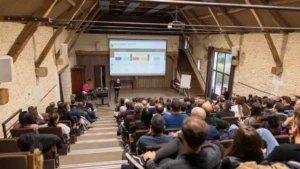
December, meeting room, two hours blocked out, a slide titled “End-of-year review”. The manager asks what worked well: seven people answer. They then ask what went wrong. A few seconds of silence, then someone mentions a tool problem. It is noted down, thanks are given, and everyone heads off to the next meeting. This team end-of-year review produced nothing, and it is not a question of method. It is a question of conditions.
Why a team end-of-year review achieves nothing in the office
Three things block the process, and they all relate to the location.
The room carries the hierarchy. It is where objectives are announced, where progress meetings are held, where the N+2 pops their head in. Saying “that decision in March cost us two months” in that room requires a courage that most people do not want to expend on a Thursday afternoon.
Time is constrained. Two hours with a meeting at 3 pm afterwards is a guarantee that difficult subjects will not come up. They require a warm-up period. You do not say awkward things in the first twenty minutes.
Attention is already elsewhere. Emails arrive, phones vibrate, someone slips away for a call. A review held between two tasks will be treated as a task.
Leaving the premises is not a question of comfort. It is what makes possible the only content that has value in a review: what no one says in a meeting.
The three ways to fail the exercise
The congratulatory round table
An easy symptom to spot: everyone agrees. Successes are listed, congratulations are shared, and the “areas for improvement” section produces two cautious remarks about tools or workload.
The cause is mechanical. In an oral round table, the first person to speak sets the acceptable level of risk, and no one will go beyond it. If the first person is cautious, the whole session will be.
The remedy is simple: never start orally. Fifteen minutes of individual and silent writing before anyone speaks. Everyone formulates their answer without knowing what the others will say, and then finds themselves committed to what they have written.
Settling scores
The opposite, rarer but more costly. The floodgates are opened without a framework, a personal issue surfaces, the session goes off the rails and the team leaves damaged.
Two safeguards are enough. Set an explicit rule at the opening: we talk about situations and mechanisms, never about people. And pass the topics through subgroups before the plenary room, which reformulates and depersonalises them in the process.
The exercise without a trace
The most frequent of the three, and the most discouraging. The session goes well, people talk, the atmosphere is good, and six weeks later nothing remains. No minutes, no action, no follow-up.
This is what kills the credibility of the exercise for the following years. A team that has seen two reviews with no effect will not invest in the third.
How much time, for how many people
The retrospective models circulating come from the agile world and are calibrated for about an hour. This is suited to a two-week sprint. For twelve months, it is highly insufficient.
| Team size | Working time | Organisation | Layout |
| 5 to 10 people | 2 hr 30 to 3 hours | Everyone together | U-shape or closed table |
| 10 to 25 people | Half a day | Subgroups of 5 to 6, then feedback | Cabaret |
| 25 to 60 people | One day | Subgroups by scope, then plenary room | Cabaret, U-shape plenary room |
| More than 60 people | 24 hours with an overnight stay | Parallel workshops, feedback the next day | Multiple rooms |
The threshold that matters is around ten participants. Beyond that, the conversation no longer flows in the whole group: the same three people speak and the others listen. You have to break into subgroups, which changes the need for rooms.
A four-step framework
- Write alone, 15 minutes. Everyone answers the questions sent in advance in writing. No discussion, no phones. It is the step most often skipped and the most decisive.
- Share in subgroups, 45 to 60 minutes. Groups of five or six, mixed if possible rather than by department. Each group consolidates what emerges and retains three findings.
- Present and group together, 30 to 45 minutes. Each group presents its three findings. Similar points are brought together. At this stage, common topics appear on their own, and they are difficult to dismiss since they have been raised from several sides.
- Consolidate, the last quarter of the time. This is the step to protect at all costs. Display the grid as soon as the session opens: action, person in charge, deadline. Three columns, visible all day. A finding that does not fit into this grid before the end will no longer exist on Monday.
Review and start of the year: the argument for the 24-hour format
Two meetings, six weeks apart, with the same team and the same logistics. The review in November or December, the launch in January. Most companies organise them separately without asking themselves why.
| Two separate times | Review and direction over 24 hours | |
| Organisation | Twice the same logistics | Only once |
| Continuity | Six weeks and holidays in between | The direction is built on the still-fresh review |
| Trace of the review | Often lost by January | Transformed into priorities the next morning |
| Travel | Two | Only one |
| To be preferred when | The review must stay within the team, the launch concerns the whole company | The same team handles both |
The benefit of the residential format lies in the overnight stay. An honest review stirs things up, and looking ahead immediately afterwards does not work well. An evening, a dinner, a night, and the next morning the same team approaches the following year with the necessary perspective. This is precisely what our 24-hour format allows.
The questions to send a week in advance
The content of the review largely depends on the quality of the questions asked beforehand. Five are enough, provided they are precise. “What did you think of the year?” produces nothing.
- Which decision from this year would you make differently, and why?
- What made you lose the most time?
- Which moment of the year are you most satisfied with?
- What have we stopped doing that you miss?
- What should I know that I do not know?
The last one is the most useful, and it is the one managers hesitate the most to ask. It opens the door without singling anyone out.
Where to hold your team review
The main criterion is a change of scenery, not prestige. A team that has driven for thirty minutes and is having lunch elsewhere is already no longer in the same state of mind.
For a team of 10 to 30 people, the Manoir des Brumes is a good fit: complete exclusive use, rooms from 55 to 100 m², and the guarantee of not crossing paths with any other group, which matters more than you might think when the conversation becomes frank. For over 40 people, the Moulin de la Forge allows you to hold the plenary session in one room and the workshops in another.
Two useful additions to the session: a walk between two sessions, which loosens tongues better than a coffee break, and a collective time at the end of the day. Our activities and workshops fit easily into this time slot. All our houses are about one hour from Paris, and access is also possible by train.
Frequently asked questions
What is the difference with the annual appraisal?
They have almost nothing in common. The annual appraisal is individual, confidential, focuses on a person’s performance and is structured. The team review is collective and focuses on how the group functions: what got stuck, what flowed well, what to do again or not. The two complement each other, but never replace one another. Be careful not to schedule them back-to-back in the same week, the atmosphere of one contaminates the other.
Should the N+2 be present?
That depends on what you are looking for. If it is a matter of raising real operational difficulties, their presence will partially stifle them, whatever their intentions. A solution that works: the team works alone in the morning, the N+2 joins the feedback session in the afternoon and leaves with the consolidated findings.
Can a year-end review be done by video call?
Technically yes, the tools exist. But the exercise relies on frankness, and frankness does not translate well through a screen, especially in a team that is not used to the format. If in-person is impossible, shorten and limit the ambition: a factual update rather than a real review.
November, December or January?
November is the best window. The year is advanced enough to be judged, and there is enough time left for the conclusions to feed into the January launch. December works but suffers from saturated schedules. January arrives too late: the following year has already been launched.
Who should facilitate?
The manager can do it if they agree to take on the role of facilitator and not participant, which is more difficult than it seems when criticisms relate to their own decisions. Entrusting the facilitation to someone else in the team, rotating from one year to the next, often yields better results.
What should be done with topics that cannot be addressed?
Name them anyway, and say so frankly. A topic that depends on a decision above the team should not be dismissed out of hand: note it down, indicate who will take it forward and to whom, and give a deadline for feedback. What the team struggles to tolerate is not the lack of a solution, it is silence.
In summary
An end-of-year team review produces value on three conditions: a venue that allows for frankness, individual writing before anyone speaks, and an action grid filled in before the end of the session. Everything else is a bonus.
If you are considering combining the review and the launch of the following year, send us your headcount and your dates: we will tell you what fits into twenty-four hours in one of our three houses. Request a quote