A countryside seminar venue near Paris is judged on facts, not on photos of a park. Direct train journey time: between one hour and one and a half hours. Capacity: to be read in theatre style, not in cocktail. CSR proof: a label awarded by a third party. Price: published, with what it includes.
What to remember
- Paris-Saint-Lazare connects to Chaumont-en-Vexin by direct train in 1 hr 07. The transport of participants is the largest source of emissions for a seminar: the access criterion comes before the scenery.
- CSR-labelled venues feature in 65% of event buyers’ consultations, and their average additional cost dropped from 22% to 16% between 2023 and 2025 (IFTM × Kactus 2025 barometer).
- The Engagé RSE label (AFNOR Certification) has four levels based on 55 ISO 26000 criteria. The Exemplary level, the highest, is achieved by about one in five labelled organisations.
- A capacity is read in theatre style: 80 seats at Manoir des Brumes, 140 at Moulin de la Forge, 200 in the amphitheatre of Domaine de Rebetz.
- The all-inclusive residential package of the three houses of Groupe Moulin de la Forge is published: from 295 to 410 € excl. VAT per participant depending on the house, the season and the room type.
Type “countryside seminar near Paris” into Google. You get about twenty pages with almost the same title: directories listing dozens of addresses, and venues that all describe themselves with the same words. None tells you how to decide. That is the role of this grid. It was written from our three houses in the Vexin, with the questions we hear on the phone, and it applies to any venue, including those of our colleagues.
“Countryside”: what the word really covers
The term has no definition. It applies just as well to a hotel with a garden in the inner suburbs as to a farm seventy kilometres away. Between the two, there are three realities.
The most frequent: a park. A building with character, lawns, trees, sometimes a body of water. The grounds serve as a backdrop for breaks and photos. It is pleasant, and it is not the countryside.
The second: a site in a forest or a valley, where you can walk, cycle, paddle. The grounds become a place for activities. Team building providers find their material there.
The third, rare: a working farm. A kitchen garden that is harvested, an orchard whose apples are pressed, animals that are raised, beehives. The grounds feed the table and provide the programme. When a venue presents itself like this, ask who works the land and what is produced there. If the answer is vague, it is a park.
For a buyer, the useful question is therefore not “is it in the countryside?” but “what grows, lives and works on these grounds, and what will my group do with it?”
Countryside seminar, residential seminar, study day: three different things
The three expressions cross paths in searches and get mixed up in quotes. “Countryside” describes the venue. “Residential” describes the format: at least one night on site, usually two days, and a package that goes from the welcome coffee to the next day’s breakfast (this is our residential seminar, which we call the 24 Hours of Happiness). “Study day” also describes the format: a working day without an overnight stay. A countryside seminar can take either format. Set the format before comparing venues, otherwise you will compare prices that do not contain the same thing.
The seven criteria, in the order they eliminate
The order matters. The first criteria rule out venues in two minutes, without a visit. The last ones can only be decided on the phone.
| # | Criterion | The question to ask | The answer that eliminates |
|---|---|---|---|
| 1 | Train access | Which station, in how much time from Paris, and who pays for the station-venue journey? | “You have to come by car.” |
| 2 | Real capacity | How many seats in theatre style in the largest room, and how many beds? | A capacity given in cocktail, or without specifying the layout. |
| 3 | Privatisation | Will we cross paths with another group in the meeting rooms, lounges or restaurant? | “It depends on the schedule.” |
| 4 | CSR proof | Which label, awarded by whom, on what date? What published figures? | An “our commitments” page without a label or figure. |
| 5 | Published price | What package excl. VAT per participant, for which season, and what does it include? | “By quote only”, without an order of magnitude. |
| 6 | What the venue does itself | Is the food prepared on site? What activities are led by the venue’s team? | Catering and entertainment entirely subcontracted. |
| 7 | One contact, one invoice | Who follows my file from the quote to departure? Do external providers go on the same invoice? | Three contacts and three invoices. |
The criterion everyone forgets: who pays for the last mile
More and more event buyers are asking for a carbon footprint, and the preference for trains is growing year on year, according to the IFTM × Kactus 2025 barometer. The transport of participants is the largest source of emissions for a seminar, far ahead of heating the rooms or meals. A venue “one hour from Paris” by car can therefore be further away, in carbon terms, than a venue an hour and a quarter away by train.
Then look at the last mile. A station ten minutes away is useless if forty people have to wait there for taxis that cannot be found. Ask who organises the shuttle and who pays for it. With us, the J line connects Paris-Saint-Lazare to Chaumont-en-Vexin directly, in 1 hr 07; the three houses are 3, 8 and 15 minutes from the Chaumont and Gisors stations, and the taxi from the station is at our expense for three or more people. A Euro 6 standard bus for the whole group? We cover 20% of the cost. These are figures to demand from any venue, not a peculiarity (see our train and car access page).
A label awarded by a third party, or an “our commitments” page
The same barometer counts CSR-labelled venues in 65% of consultations, and notes that their average additional cost dropped from 22% in 2023 to 16% in the first half of 2025. The subject has become a selection criterion, no longer an extra.
The difficulty is that everyone claims to be committed. Three questions help you decide. Who verified it? A third-party organisation that audited on site, or the venue itself? What level? The Engagé RSE label (AFNOR Certification), for example, evaluates 55 criteria from the ISO 26000 standard and classifies organisations into four levels, from Initial to Exemplary; the Exemplary level is only achieved by about one in five labelled organisations. Finally, what figures? A rate of recycled waste, a share of purchases from short supply chains, a number of recorded species, with a date.
Our group is awarded the Engagé RSE label, Exemplary level, and publishes ten quantified commitments, including 80% sourcing from short supply chains and 90% of waste recycled or composted. We state this here because it is verifiable, and because it is precisely the type of proof to demand elsewhere.
Single venue, national network or platform: who to ask
A search comes up in AI assistants in this form: “Châteauform’ or Naboo for a countryside seminar near Paris?” The question mixes two things. One is a network of houses, the other a booking platform. There are in fact three models, plus a fourth, lesser-known one.
| Model | What it does well | What it does less well | For whom |
|---|---|---|---|
| Platform (Naboo, Kactus, Aleou) | Quickly compare dozens of addresses, centralise quotes | Visits nothing, does not know the venue; the relationship remains with an intermediary | A broad initial list, a formal call for tenders |
| National network (Châteauform’, Center Parcs) | An identical standard everywhere, system labels, a structured invoice | Little unique character for each address; the contact person changes depending on the house | Groups that multiply seminars in several regions |
| Single venue | A character, a team that knows its walls, a direct relationship | A single date, a single capacity; if it is fully booked, you have to start all over again | A group of stable size, a flexible date |
| Group of houses in the same area | The character of a single venue, with several capacities and several dates under a single contact | A single geographical area | A group that returns every year, or whose size varies |
Our opinion, since we are asked: start with the platform for the list, not for the choice. Then call two or three venues directly and ask them the seven questions from the previous table. A venue that answers with figures on the phone will answer with figures on the invoice.
Which house for which group size
The fourth model is ours, and it illustrates criterion 2. Groupe Moulin de la Forge brings together three houses within a 20 km radius, in the Vexin, one hour northwest of Paris. They do not look alike and do not host the same groups.
| House | Town, station | Largest room (theatre style) | Bedrooms, beds | What characterises it |
|---|---|---|---|---|
| Manoir des Brumes | Bouchevilliers (Eure), Gisors 15 min away | 80 seats (Le Moulin room, 100 m²), 4 rooms | 47 bedrooms, 94 beds | Manor listed as a Historic Monument, 5 ha park bordered by the Epte, semi-covered swimming pool |
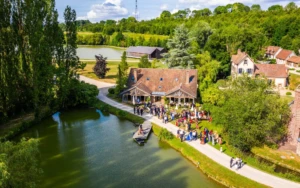
| Moulin de la Forge | Le Vaumain (Oise), Chaumont-en-Vexin 8 min away | 140 seats (L’Étang room, 170 m²), 3 rooms | 64 bedrooms, 112 beds | Former farm and water mill; 5 ha of ponds, permaculture kitchen garden, conservatory orchard, herd of deer |
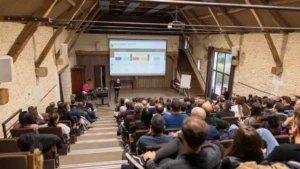
| Domaine de Rebetz | Chaumont-en-Vexin (Oise), station 3 min away | 200 seats (amphitheatre, 210 m²), 6 rooms | 89 bedrooms, 160 beds | Former seigneury, dovecote, 65 ha park, golf driving range |
Read the “theatre style” column as a ceiling. An executive committee seminar of twelve people fits in the salle des Templiers of the Manoir; a convention of 180 managers only fits in the amphitheatre of Rebetz. Between the two, the Moulin hosts groups of 40 to 140, and this is where the grounds are most part of the programme: the market gardener takes the team to harvest in the kitchen garden what they will cook in the evening with the kitchen brigade, and the juice served at the break comes from the orchard.
What applies to all three: meeting rooms, lounges and dining areas entirely reserved for your group, a sales representative who follows your file from the quote to departure, a house manager on site, and a single invoice, including our partners’ activities.
What budget to plan, and when to book
Criterion 5 deserves a clarification. A “from” price says nothing as long as you do not know what it contains. A complete residential package covers the welcome coffee, the equipped room, two breaks, lunch and dinner with drinks, a private lounge for the evening, the night and breakfast. Many venues invoice some of these items separately, and the total then exceeds the package displayed by a seemingly more expensive competitor.
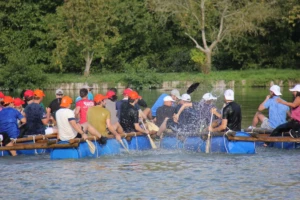
Our residential packages are published on our booking page: from 295 to 345 € excl. VAT per participant in a shared room and from 350 to 410 € excl. VAT in a single room, depending on the house and the season. The high season runs from late August to October and from May to mid-July; the low season covers November to April and the second half of the summer. Supervised activities (Golf Introduction, Orienteering and Raft Race, kitchen garden workshop, Climate Fresk) are added, with their price indicated in the catalogue.
On dates: searches for seminar venues peak in September and March. For a group of more than a hundred people, book at least half a year in advance, because few countryside houses host them and their dates go first. For twenty people, a month is often enough outside the high season.
One last rule, the simplest. Ask the seven questions in writing, to the three venues you have shortlisted. The one that answers with figures, room names and a label date has already answered the eighth question, the one we dare not ask: can I trust them?
Do you have a date, a group size and an objective? Send us your brief: we will answer with the suitable house, room and package, in figures. Let’s build together
Frequently asked questions
Where to find a countryside seminar one hour from Paris by train?
On the Transilien J line, from Paris-Saint-Lazare. Chaumont-en-Vexin is served directly in 1 hr 07, Gisors a little further on. The three houses of Groupe Moulin de la Forge are 3, 8 and 15 minutes from these stations, and the group covers the taxi from the station for three or more people. The RER A to Cergy-le-Haut is a second option for Domaine de Rebetz, 25 minutes away by car.
Does a countryside seminar cost more than a city hotel?
Not necessarily, provided you compare complete packages. A countryside residential package includes the room, breaks, meals with drinks, the night and breakfast. The three houses of Groupe Moulin de la Forge publish theirs: from 295 to 410 € excl. VAT per participant. An urban hotel often invoices the room, catering and accommodation separately, which masks the total.
How to check that a seminar venue is truly eco-responsible?
Ask for a label awarded by a third-party organisation and its date: Engagé RSE label (AFNOR Certification), Clef Verte, ISO 20121. Then ask for published and dated figures, for example the share of sourcing from short supply chains or the rate of recycled waste. An “our commitments” page without figures or an external audit describes an intention, not a result.
Can you entirely privatise a countryside venue in Île-de-France?
Yes, but the word covers different realities. Some venues privatise a room, others all the indoor spaces. Ask the question like this: will we cross paths with another group in the meeting rooms, lounges or restaurant? In the houses of Groupe Moulin de la Forge, meeting rooms, lounges and dining areas are entirely reserved for your group; you only cross paths with other participants outside.
What is the best time for a countryside seminar near Paris?
May to mid-July and September-October are the most requested months, which is reflected in the high season rates. November to April and the second half of the summer offer lower prices and more available dates. A back-to-work seminar is booked before the summer, a spring seminar before the end of the previous year, especially for a group of more than a hundred people.
What is the difference between a countryside seminar, a residential seminar and a study day?
“Countryside” describes the venue: out of the city, with grounds. “Residential” describes the format: at least one night on site, generally two days. “Study day” also describes the format: a working day without an overnight stay, from the welcome coffee to departure. A countryside seminar can therefore be residential or fit into a study day.
Sources
- IFTM × Kactus, 2025 Corporate Events Barometer: share of certified venues in consultations, average additional cost, preference for trains.
- AFNOR Certification, Engagé RSE label: ISO 26000 framework, 55 criteria, four levels, three-year validity.
- Rydge, The AFNOR Engagé RSE label: decoding: distribution of labelled organisations by level.
- Transilien, J line timetables, Paris-Saint-Lazare to Chaumont-en-Vexin and Gisors. Time recorded on 25 September 2026, to be rechecked on the day of publication.
- Groupe Moulin de la Forge, published residential packages and ten quantified commitments, recorded on 25 September 2026.