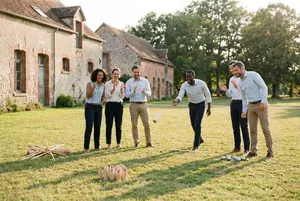
A culinary team building is a workshop where a team cooks a meal together that they then eat. At the farm, it starts outside: harvesting in the kitchen garden with the market gardener, cooking with the house brigade, dinner that same evening. Duration: three hours. Price: 60 € per person, published by the group for 2026.
What to remember
- A culinary team building at the farm lasts three hours and produces the evening dinner: the team harvests in the kitchen garden with the market gardener, then cooks with the house brigade. Published price: 60 € per person.
- The zero waste version takes place in the group’s three houses in two hours, at 50 € per person: every part of every ingredient is used, including peelings and tops.
- In France, food waste represents around 10 million tonnes per year according to ADEME; on its sites, the group recycles or composts 90% of its waste.
- Team cooking in the garden is scheduled for the late afternoon of the first day of a residential seminar; it depends on the season and the weather. The zero waste version, however, takes place all year round.
- What distinguishes the workshop at the farm from the studio workshop comes down to one question: where do the vegetables come from? Here, from the permaculture kitchen garden a hundred metres from the kitchen, and 80% of the supply comes from short supply chains.
Search for “team building cuisine” and you will come across cooking schools and studios, almost all in Paris: a chef, a worktop per team, ingredients delivered in the morning, a tasting at the end. It is well done and it works. It is not the only way to cook as a team, and it is not the one that leaves the most memories. We have been hosting seminars since 1990 in three houses in the Vexin, including a working farm. Here is how a cooking workshop happens with us, step by step, and what it changes.
Three ways to cook as a team, and what you eat at the end
Behind the same expression, three formats that do not have the same starting point or the same end.
| Studio class | Team challenge | Team cooking at the farm | |
|---|---|---|---|
| Where | A cooking workshop in the city | A kitchen or an equipped room | The kitchen garden, then the house kitchen |
| The ingredients | Bought, delivered in the morning | A set basket, identical for everyone | Harvested by the team, with the market gardener, according to the season |
| Who supervises | A workshop chef | A facilitator, sometimes a jury | The market gardener, then the brigade that cooks every day for the house |
| What you eat | A tasting, often standing | The competition dishes, scored | The seminar dinner, at the table, in the garden if the weather permits |
| What remains | A recipe, a photo | A ranking | The meal, and the habit of looking at what grows |
The team challenge is the most sold format, because it tells a good story. The studio class is the safest. Team cooking at the farm is the only one of the three where the group actually eats what they have made, at dinner, with everyone. It is this detail that changes the atmosphere of the evening.
“Brigade”: what a kitchen team is called
The question comes up often, and the answer says something about the format. A kitchen team is called a brigade, a word inherited from the organisation codified by Auguste Escoffier at the end of the 19th century: a chef, sous-chefs, chefs de partie, commis chefs, each at their station. In a team cooking session, the house brigade, the one that usually prepares the seminar meals, supervises the participants station by station. For the duration of a dinner, it is your team that becomes the brigade.
The schedule, from harvest to dinner
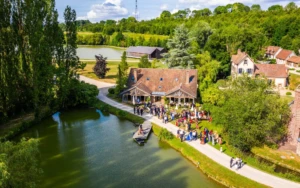
Team cooking in the garden takes place at the Moulin de la Forge, the house that has the kitchen garden, and it lasts three hours minimum. Here is the typical sequence, the one described in our catalogue, with what everyone does; the details are adjusted to the season and the group.
| Time | What happens | Who leads |
|---|---|---|
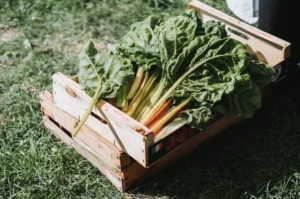
| Start | Meeting at the kitchen garden. The market gardener explains what is ripe, what is not, and why. The evening menu is decided there, with what is available. | The market gardener |
| First hour | Harvesting in sub-groups: everyone leaves with their part of the menu. You learn to pick without damaging the plant, to leave what is not ready. | The market gardener, the team |
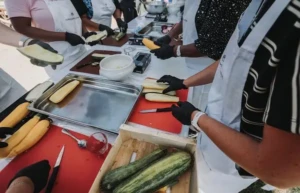
| Second hour | Washing, peeling, cutting, cooking. The brigade assigns the stations and corrects the techniques. Each sub-group handles a part of the menu. | The brigade |
| Third hour | Plating and service. If the weather permits, the workshop and the meal are held in the garden. Otherwise, in the dining room. | The brigade, the team |
| The evening | The seminar dinner is the one the team has cooked. Aperitif and evening follow, as in the package. | Everyone |
The zero waste version, in the three houses
When the season does not allow for harvesting, or for a group staying at the Manoir des Brumes or at Rebetz, the workshop takes place in the kitchen, in two hours, at 50 € per person. The principle: use every part of every ingredient. The tops, the peelings, the stems, what usually goes in the bin becomes a broth, a garnish, a condiment. The brigade shows the techniques; the team cooks.
The subject goes beyond the exercise. In France, food waste represents around 10 million tonnes per year according to ADEME, all along the chain, from the field to the plate. On its sites, the group recycles or composts 90% of its waste, it is one of its ten commitments. The workshop does not change this national figure. It changes the way twenty people will look at a carrot top the following Monday, and that is already a mark, in the sense we mean for a CSR team building.
What changes when the kitchen garden is a hundred metres from the kitchen
Most cooking workshops buy their ingredients. Here, they grow. The Moulin de la Forge is a former farm with a kitchen garden cultivated in permaculture, a conservatory orchard of apple trees whose juice is pressed on site, beehives, and a kitchen that works with these products all year round: the break juice, the fruit jellies, the terrines, the cider. Team cooking is not an activity added to the venue, it is a slice of what the venue already does, open to the group for three hours.
The kitchen of the three houses is committed to 80% supply from short supply chains, prepares on site, offers entirely vegetarian alternatives from the kitchen garden and adapts to diets and allergies reported in the brief. The group is awarded the Engagé RSE label (AFNOR Certification), Exemplary level. For Mathieu, who has to justify the activity to his management, all this comes down to one sentence: the workshop is consistent with the venue, and the venue proves it.
A necessary honesty: team cooking in the garden depends on what the kitchen garden yields. It is at its best when the harvest is abundant, and we prefer to offer the zero waste version rather than an empty garden. Give us your date, we will tell you what will be possible.
Capacity, duration, price, and where to place it in the seminar
The capacity. A cooking workshop is conducted in sub-groups of four or five around a station. Beyond about thirty participants, several teams must be planned in parallel, each with its part of the menu, and the dinner brings everything together. For a group of a hundred people, the workshop can only involve a part of the group while the others do another activity at the venue, then everyone meets at the table.
The duration and the timing. Three hours for the garden, two for zero waste. The natural place is the late afternoon of the first day of a residential seminar: the last session ends, you go out, you harvest, you cook, and the workshop leads directly into the dinner and the evening. In a study day, the two-hour version is placed before lunch, which becomes the cooked meal. For a team cohesion seminar, it is often the main activity.
The price. 60 € per person for team cooking in the garden, 50 € for zero waste, published in the 2026 activities catalogue. These amounts are added to the package, which already includes meals, breaks, drinks and free-access activities. Compare with a Parisian studio by adding the group’s return transport and the time lost: the workshop at the farm is held where the team sleeps.
What the team takes home, besides dinner
A studio workshop ends with a printed recipe. Here, what remains fits in a basket. The house produces its own terrines and stews, its apple juice pressed on site, its fruit jellies, its cider, its honey. These are the products that the team saw growing or tasted during the break, and the group puts together gift boxes from this production, for the participants or for their clients. It is not a promotional item: it is what the venue itself eats.
Cohesion, however, cannot be taken home in a basket. It comes down to a specific memory: the evening when the team served its own dinner to the entire seminar, without a jury, with the market gardener and the brigade at the table. It is this memory that the participants talk about, and it is unlike any cooking class.
Do you have a date and a number of participants? Send us your brief: we will tell you what the kitchen garden will allow that day, and we will propose the workshop, the brigade and the menu. Let’s build together
Frequently asked questions
What is a culinary team building?
It is a workshop where a team prepares a meal together, supervised by cooks, then shares it. It exists in three forms: the cooking studio class, the competition-style team challenge, and team cooking at the seminar venue, where the group harvests the ingredients themselves and cooks their dinner with the house brigade. The result is not a tasting but the actual evening meal.
What is a kitchen team called?
A brigade. The word comes from the organisation of restaurant kitchens codified by Auguste Escoffier at the end of the 19th century: a chef, sous-chefs, chefs de partie, commis chefs, each at a station. In a team cooking session, the house brigade supervises the participants station by station; they are the ones who usually serve the seminar meals, and it is your team that replaces them for the duration of a dinner.
What are the best dishes to cook as a group?
Those that can be shared and divided into stations: a dish to assemble, a garnish, a dessert, each entrusted to a sub-group of four or five.
How much does a cooking team building cost?
At Groupe Moulin de la Forge, the prices are published by the group for 2026: 60 € per person for team cooking in the garden, three hours minimum, at the Moulin de la Forge depending on the season; 50 € per person for zero waste team cooking, two hours minimum, in the three houses. These amounts are added to the seminar package, which already includes meals and free-access activities.
Can you do a culinary team building with vegetarians or allergies?
Yes. The kitchens of the three houses of Groupe Moulin de la Forge prepare on site and adapt to dietary requirements, and offer entirely vegetarian alternatives from the kitchen garden. You simply need to report diets and allergies at the time of the brief, just like for the seminar meals, so that the brigade can organise the stations accordingly.
When is the best time to do team cooking in the kitchen garden?
When the kitchen garden yields, which depends on the season and the weather: the group’s catalogue specifies this for team cooking in the garden. Out of season or in bad weather, the zero waste version takes place in the kitchen, all year round, in the three houses. The simplest way is to give your date: the venue will tell you what the garden will allow that day.
Sources
- ADEME, food waste in France: national order of magnitude.
- Groupe Moulin de la Forge, 2026 CSR activities catalogue: garden team cooking and zero waste team cooking, durations and prices; ten commitments: short supply chains, waste. Recorded on 25 September 2026.
- Auguste Escoffier, Le Guide culinaire (1903): organisation of the kitchen brigade.