A CSR team building is a team activity that produces a measurable effect outside the meeting room: something planted, harvested, repaired or learned, and a trace that remains after departure. To sort them out, four questions: where the action takes place, what remains, who measures, who facilitates.
What to remember
- A CSR team building is judged by what remains on site the next day: a monitored beehive, a planted row, a cooked menu, an acquired skill. An indoor workshop with no follow-up is not one.
- CSR-labelled venues feature in 65% of event buyer consultations and their average additional cost fell to 16% in 2025 (IFTM × Kactus 2025 barometer).
- A Climate Fresk or a 2 Tonnes Workshop lasts three hours at a minimum and is scheduled in groups of sixteen: for forty participants, plan for three parallel groups, therefore three rooms or three separate tables.
- At Groupe Moulin de la Forge, a biodiversity walk costs 120 € for a group of fifteen, discovering the beehives 150 €, Team Cooking: Zero Waste 50 € per person: prices published by the group for 2026.
- On the group’s grounds, over 80 animal species are recorded, including 42 rare or protected ones; 90% of waste is recycled or composted. It is these figures, not intentions, that the activity makes tangible.
Type “CSR team building” into a search engine. You get lists of sixteen ideas, ten ideas, eight ideas, all signed by event agencies. They are not bad. They have one flaw: nothing says, before paying, whether the activity will produce anything other than a group photo. We have been hosting seminars since 1990 in three houses in the Vexin, and we have seen many “CSR days” go by. Here is how we judge them, and this grid applies to any venue.
What “CSR team building” covers today
The expression is recent and vague. It is used to designate a quiz on waste sorting in a meeting room just as much as a morning spent replanting a hedge. Buyers, however, have decided: according to the IFTM × Kactus 2025 barometer, CSR-labelled venues feature in 65% of consultations, and the average additional cost of a certified event fell from 22% to 16% between 2023 and 2025. The subject has become a purchasing criterion. It does not, however, have a definition.
Ours fits into one sentence: a CSR team building leaves a trace that can be shown the next day. A beehive whose production is monitored. A pruned orchard row. A dinner cooked without throwing anything away. A skill, if the workshop has genuinely taught the group something. Everything else is team building, which is not a criticism, but it is not the same thing.
CSR, ecological, solidarity: three words, three scopes
The three are confused in catalogues. They do not designate the same thing. An ecological team building acts on living things: biodiversity, waste, climate. A solidarity team building acts for people: a charity, a project useful to others, a donation of time. A CSR team building encompasses both and adds the way the activity itself is carried out: where the suppliers come from, how you travelled, what you throw away. This is the breakdown of the ISO 26000 standard, which organises social responsibility into seven core subjects, including the environment, local communities and fair operating practices. When people talk to you about the “three objectives of CSR”, they generally summarise this: the environment, social issues, and the way of doing business.
Four questions to sort them out, before looking at the price
Ask the agency or the venue these in writing. Vague answers eliminate more surely than a high price.
| Question | What it verifies | Reassuring answer | Eliminating answer |
|---|---|---|---|
| Where does the action take place? | That the action takes place where you are, on real ground | “In our orchard, on our beehives, in our kitchen garden.” | “We plant trees for you remotely.” |
| What remains? | That there is a trace after your departure | “The hedge, the compost, the walk’s record, the recipe.” | “A highlight and memories.” |
| Who measures? | That a figure exists, dated, preferably verified by a third party | “The venue is labelled, its figures are published, here are ours.” | “We are very committed.” |
| Who facilitates? | That the person knows the ground or the method | “Our market gardener, our beekeeper, a trained facilitator.” | “An event host.” |
The first question is the one that matters most. An activity carried out hundreds of kilometres away, or offset by a payment, has no link with the group financing it. It may be useful. It builds nothing between the people experiencing it, because they are not experiencing it.
Four families of activities, and what each produces
Catalogues line up dozens of names, ours included (our twelve activities). They fall into four families, which do not produce the same thing and are not scheduled at the same time during the seminar.
| Family | Examples (the group’s 2026 activity suggestions) | What it produces | Duration, capacity, published price |
|---|---|---|---|
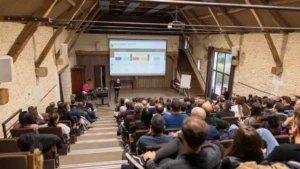
| Understand | Climate Fresk, Biodiversity Fresk, Digital Fresk, 2 Tonnes Workshop, Deep Time Walk, Journey to the Glorious 2030s | A shared skill, a common vocabulary, sometimes an action plan | 3 hours, per table of 16, upon quote; Glorious 2030s 2 hours, 10 to 50 people |
| Do | Biodiversity walk, discovering the beehives and honey tasting, terrarium, kokedama | A record, an observation, a living object to take home | 1 hr 30; walk 120 € per group of 15, beehives 150 € per group of 15, terrarium and kokedama upon quote |
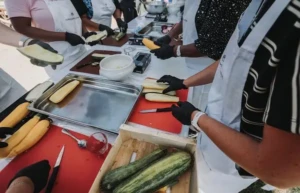
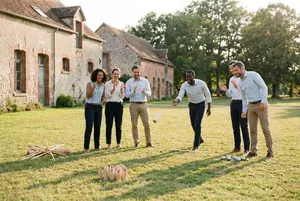
| Cook | Team Cooking: Zero Waste (the three houses), team cooking in the garden (Moulin, depending on season) | The evening dinner, cooked with what was harvested, without throwing anything away | 2 hours at 50 € per person; 3 hours at 60 € per person in the garden |
| Give | Solidarity actions with Connexion Nature, partner CSR team building agency | A project or action useful to others, outside the group | Upon quote, invoiced on the same quote as the stay |
A scheduling tip, drawn from what works for us: “understand” in the morning, when minds are fresh; “do” or “cook” in the afternoon, outside, when attention drops and the body needs to move. A fresk after lunch is a fresk half lost.
What changes when the venue is itself a farm
Most CSR activities sold during seminars are imported: an agency arrives with its equipment, facilitates, and leaves. Nothing prevents doing this in a park. But when the venue is a working farm, the activity changes in nature: it focuses on what already exists, and what exists continues after the group’s departure.
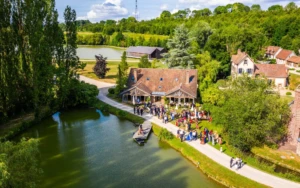
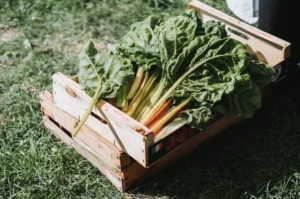
At Moulin de la Forge, the biodiversity walk covers grounds where over 80 animal species are recorded, including 42 rare or protected ones. Discovering the beehives ends with the house’s honey. Team cooking in the garden starts with the market gardener, in a kitchen garden cultivated using permaculture: the team harvests what is ripe, the kitchen brigade helps them cook it, and it is the evening dinner. The conservatory orchard provides the juice for the break. None of these activities were invented for the seminar: they carve out a slice of what the farm does all year round.
The framework is measured and verified by a third party. The group holds the Engagé RSE label by AFNOR Certification at the Exemplary level, the highest of the four, and publishes ten quantified commitments: 90% of waste recycled or composted, 80% sourcing via short supply chains, 100% of teams trained in eco-friendly practices. For the organiser who has to report back, this is the third piece of evidence, the one she does not have to produce herself. It is also what structures our CSR seminar format: proving, not just displaying.
What we do not do ourselves, we entrust to a partner who knows the ground: Connexion Nature, a CSR team building agency, whose solidarity actions go on the same quote and the same invoice as the stay. A single budget line.
How much time, how many people, how much it costs
Three constraints come up in every request, and they are settled before choosing the activity.
Time. A fresk or a 2 Tonnes Workshop takes three full hours. In a study day, that is half the working time. In a two-day residential seminar, this is placed at the end of the first day or the beginning of the second, without cutting into the sessions. The “do” and “cook” activities take one and a half to three hours and fit naturally between the last session and the aperitif.
Numbers. Understanding workshops are scheduled in groups of sixteen. Forty participants means three parallel groups, and enough to separate them. Field activities are limited to fifteen per group: beyond that, you rotate, and the programme is built in parallel workshops. A group of 120 people does not do one biodiversity walk; it does eight, or it combines.
Price. Ours are published in the 2026 CSR activities catalogue: 120 € per group for the biodiversity walk, 150 € per group for the beehives, 50 € per person for Team Cooking: Zero Waste, 60 € for the garden one, and upon quote for the fresks and long workshops. These amounts are added to the seminar package, which already includes free-access activities: bicycles, campfire, sports equipment, games. Always ask what is included before comparing two activity quotes.
The mistakes that turn a CSR team building into a PR stunt
We see them coming back, here as elsewhere.
- The workshop with no follow-up. A fresk on a Thursday, nothing on Friday. The activity created a vocabulary; a decision is needed, even a small one, taken immediately by the group, otherwise the vocabulary evaporates.
- The delegated action. Trees planted “in your name” on the other side of the country. No one saw them. The action may be useful, it is not collective.
- The capacity ignored. Sixty people, one facilitator, one walk. Two-thirds of the group hear nothing and look at their phones.
- CSR on the podium. An opening speech on the company’s commitment, then an unrelated activity. Participants tell the difference in thirty seconds.
- The venue that contradicts the activity. A climate fresk in a venue with no train access, no sorting, no published figures. The inconsistency is visible, and that is what is remembered.
The rule that avoids these five mistakes fits on one line: first choose the venue, because it determines what is actually possible to do, then the activity, then the speech. In that order. For the first choice, we have written a grid of seven criteria to choose your countryside seminar venue; the fourth criterion is precisely the CSR proof.
Do you have a date, a number of participants and an intention? Send us your brief: we will reply with the possible activities on that day, on the ground, with their duration and price. Let’s build together
Frequently asked questions
What is a CSR team building?
It is a team activity whose effect goes beyond group cohesion: it leaves something verifiable, a planted hedge row, a monitored beehive, a meal cooked without waste, or an acquired skill on climate or biodiversity. The difference with a classic team building lies in this trace, and the possibility of showing it to management with a figure or a dated photo.
What is the difference between CSR, ecological and solidarity team building?
Ecological team building acts on the environment: biodiversity, waste, climate. Solidarity team building acts for people: a charity, a project useful to others. CSR team building encompasses both, plus the way the activity itself is organised: local suppliers, transport, waste. The ISO 26000 standard links these subjects to the core issues of social responsibility.
How long does a Climate Fresk take in a company?
Three hours at a minimum, per group of sixteen participants, with a trained facilitator. For forty people, you therefore need three groups run in parallel and enough to separate them. The Biodiversity Fresk, the Digital Fresk and the 2 Tonnes Workshop follow the same format: three hours, sixteen people per group, upon quote.
How much does a CSR team building cost?
At Groupe Moulin de la Forge, prices are published by the group for 2026: biodiversity walk 120 € per group of fifteen maximum, discovering the beehives 150 € per group of fifteen, Team Cooking: Zero Waste 50 € per person, team cooking in the garden 60 € per person. The fresks and the 2 Tonnes Workshop are upon quote, per group of sixteen. These amounts are added to the seminar package.
What CSR activities for a countryside seminar near Paris?
Those that the venue can bring to life on its own grounds: a walk with recorded flora and fauna, discovering the beehives and honey, a harvest in the kitchen garden followed by cooking dinner, an indoor fresk. In the three houses of Groupe Moulin de la Forge, in the Vexin one hour from Paris, these activities are led by the venue’s team or by a partner invoiced on the same quote.
How to prove the impact of a CSR team building to management?
With three dated elements: what was done (number of participants, duration, specific action), what remains on site (before and after photo, or record of the venue), and the framework of the venue itself (label awarded by a third party, published figures). A venue holding the Engagé RSE label by AFNOR Certification provides this third element with no additional work for the organiser.
Sources
- IFTM × Kactus, 2025 Corporate Events Barometer: share of certified venues in consultations, average additional cost.
- ISO, ISO 26000, guidance on social responsibility: the seven core subjects.
- AFNOR Certification, Engagé RSE label: framework, levels, validity.
- The Climate Fresk, fresqueduclimat.org, and 2tonnes, 2tonnes.org: workshop format.
- Groupe Moulin de la Forge, 2026 CSR activities catalogue and ten commitments, recorded on 25 September 2026.