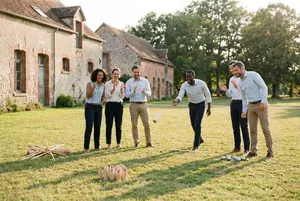
The most effective team cohesion games require little equipment: a mölkky set, pétanque boules, a volleyball net, a campfire. In an all-inclusive package seminar, this equipment is often already included. Twelve games, classified by what they produce, can therefore be played without adding a line to the quote.
What you need to remember
- A successful cohesion game produces a common result and mixes departments; a game that ranks individuals or puts the least sporty on the spot produces the opposite effect.
- In the three houses of Groupe Moulin de la Forge, the package includes free access to football, volleyball, badminton, pétanque and mölkky equipment, mountain bikes, table tennis, billiards, table football, board games and the campfire.
- Twelve games are played with this equipment or without any: four to cooperate, four to decide quickly, four to talk to each other. None requires a professional facilitator.
- A supervised activity is justified when it brings what the group cannot do alone: knowledge (fresk, beehives), a terrain (canoeing on the Epte), a supervisor (Golf Introduction). According to the group’s 2026 rates, they cost from 50 to 60 € per person.
- The rule that makes all games work: draw teams at random by mixing departments, and keep them from the morning work session until the afternoon game.
The lists of “28 games”, “30 games”, “32 games” for cohesion are made for the office: a post-it, a paperclip, a meeting room. They forget a frequent situation. You have booked a seminar, the package is signed, and you are looking for an afternoon activity without reopening the budget. We have been welcoming teams since 1990 in three houses in the Vexin, and we often see the same paradox: a group pays for an activity while the pétanque equipment, the volleyball net and the mountain bikes wait under the courtyard. Here is how to use them.
What a cohesion game must produce, and what it must avoid
A cohesion game is not a tournament. It must produce two things: a result obtained together, and conversations between people who do not speak to each other at the office. It must avoid two things: ranking individuals, and putting those who are not sporty on the spot. A one-on-one table football game between the sales director and the intern is not a cohesion game. The same table football game in randomly drawn pairs, which mix departments, is one.
Cohesion game, cooperative game, team building
The three words overlap. A cooperative game is a game where you win or lose together, against the game and not against others; it is a well-known family of popular education. A cohesion game is a game, cooperative or not, that is played for what it does to the group rather than for the score. A team building is the entire activity, games included, often supervised and invoiced. This article talks about the first two, and what distinguishes them from the third: the price.
What the package already provides
In our three houses, the seminar package includes free access, without supplement: football, volleyball, badminton, pétanque and mölkky equipment, mountain bikes, table tennis, billiards and table football, board games, and the campfire in the evening. Added to this, depending on the house, are the indoor swimming pool and hammam at Moulin de la Forge, the semi-covered swimming pool at Manoir des Brumes, the golf driving range and tennis at Domaine de Rebetz. This is the list of our 2026 packages; other venues have other facilities, the question to ask is the same: what is already included?
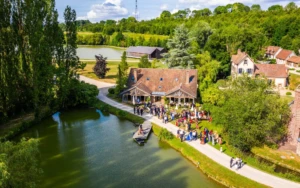
The terrain matters as much as the equipment. A mölkky is played on a lawn, volleyball on a flat space, a mountain bike race on paths. Our houses each have their own grounds, from five to sixty-five hectares depending on the house: there is no need to look for somewhere to play.
The twelve games, classified by what they produce
We arrange them into three families. Cooperate: the group achieves a common goal. Decide quickly: the teams must organise themselves under constraint. Talk to each other: the game serves as a pretext for conversation. The durations and numbers are orders of magnitude, to be adapted to your group.
| Game | The rule that makes it a cohesion game | Equipment | Players, duration |
|---|---|---|---|
| Cooperate | |||
| Exact score mölkky | Teams of four drawn at random; you must reach exactly 50 points, which forces discussion of each throw. | Mölkky (included) | 8 to 24 players, 45 min |
| Three-touch volleyball | Each team must touch the ball three times before returning it, and each player must have touched it at least once before a point counts. | Net and ball (included) | 8 to 16 players, 30 min |
| Walking football | Running is forbidden; a foul if you run. The game becomes accessible to all, and the sportiest must pass the ball. | Ball (included) | 10 to 20 players, 30 min |
| Cooperative board game | A game where the table wins or loses together against the game. Tables of four to six, one player per different department. | Board games (included); bring a cooperative game if you have one | 4 to 6 per table, 45 min |
| Decide quickly | |||
| Pétanque in randomly drawn triples | The triples change at each end; you never play twice with the same people. | Boules (included) | 12 to 30 players, 1 hour |
| Round-the-table table tennis | Everyone around the table, you hit once and move to the other side; one foul and you are out. The last ones remaining bring everyone back in for the next round. | Table and bats (included) | 8 to 20 players, 20 min |
| Rotating doubles badminton | Mixed doubles by department; at each set, one player from each pair changes sides. | Rackets and shuttlecocks (included) | 8 to 16 players, 40 min |
| Inter-department table football and billiards | Pairs composed of two different departments; the ranking is done by department, not by player. | Table football, billiards (included) | 8 to 24 players, 45 min |
| Talk to each other | |||
| The silent line | The group lines up by date of birth, then by seniority in the company, without saying a word. | None | 10 to 40 players, 10 min |
| Two truths and a lie | Everyone says three things about themselves; the others guess the false one. To be played in the afternoon teams, not in the plenary room. | None | 5 to 8 per group, 20 min |
| The three-voice story | A story about “our team in a year” is built one sentence per person, taking turns. | None | 6 to 12 per group, 15 min |
| Questions by the fire | In the evening, everyone draws a question (“the best decision of your year?”) and answers it in one minute. | Campfire (included) | 10 to 30 players, 45 min |
For a two-day seminar, one game from each family is enough: a “cooperate” on the afternoon of the first day, a “talk to each other” at the campfire in the evening, a “decide quickly” in the early afternoon the next day, before the debriefing.
Facilitating without a facilitator: five rules
- Draw teams at random, and mix departments. Without this, everyone plays with those they know, and the game reinforces the barriers it was supposed to open.
- Keep the morning teams. If the work session was done in subgroups, the same ones play in the afternoon. The game extends the work.
- Entrust the rule to someone who is not the manager. The manager plays, like the others. Someone else announces, keeps time and referees.
- Offer a role to those who do not play. Referee, scorer, photographer: no one stays on the sidelines watching.
- Finish with five minutes of discussion. Only one question: “What worked in our team?” This is where the game becomes a cohesion session.
When to pay for a supervised activity, and when it is not worth it
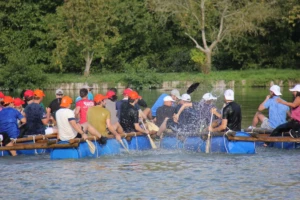
The question “what is the average price of a team building?” comes up in all searches. The honest answer: from zero to several hundred euros per person, and the difference is not due to the effect on cohesion. A supervised activity is justified when it brings what the group cannot do alone. Knowledge: a climate fresk, Discovering the Beehives. A terrain: the mountain bike and canoe rally on the Epte at Manoir des Brumes, the raft race on the Moulin pond. A supervisor: Golf Introduction with a professional at Rebetz. According to the group’s 2026 rates, these activities cost from 50 to 60 € per person, and we describe them among our 48 activities.
For everything else, the games in this table are enough. A successful team cohesion seminar is not the one that paid for the most original activity, it is the one where the morning teams are still together at dinner. If your goal is mainly to create bonds, start with the free games and keep the budget for a single supervised activity, one that produces something: a CSR team building that leaves a mark, for example.
To place these games in a day or in a two-day seminar, we have detailed an hour-by-hour cohesion day schedule, and the team cohesion seminar format describes what each house brings to it. For a residential seminar, the evening campfire often does more for cohesion than the rest of the programme.
Do you have a date and a number of participants? Send us your brief: we will tell you what is already included in the package of the house that suits you, and what is worth adding. Let’s build together
Frequently asked questions
What are the free activities for a team building?
Those that rely on already available equipment or no equipment: mölkky and pétanque in randomly drawn teams, volleyball or walking football, round-the-table table tennis, cooperative board games, silent line, questions by the fire. In an all-inclusive package seminar, this equipment is often included: at Groupe Moulin de la Forge, it is freely accessible in the three houses, without supplement.
What are the best cooperative games for adults?
Those where you win or lose together, and where everyone has a role with no physical level required. The silent line (lining up by date of birth without speaking), mandatory three-touch volleyball, exact score mölkky in mixed teams, a cooperative board game. What matters more than the game: the randomly drawn teams, and a five-minute discussion time at the end.
What is the average price of a team building?
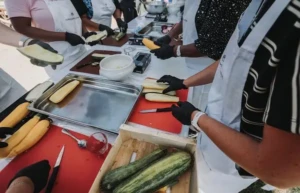
It varies from zero to several hundred euros per person depending on whether it is supervised or not. At Groupe Moulin de la Forge, supervised activities have a price published by the group for 2026: from 50 to 60 € per person for team cooking, orienteering races or Golf Introduction, 120 € per group for the Biodiversity Walk. Games played with freely accessible equipment cost nothing more than the package.
What cohesion games to play without equipment?
The silent line, where the group lines up by date of birth without speaking; two truths and a lie, where everyone guesses about the others; the three-voice story, where a story is built one sentence each; questions by the fire, one per person. They can be played anywhere, indoors or outdoors, and only require someone to give the rule and the time.
What team game to play if it rains during the seminar?
Move indoors without changing teams: round-the-table table tennis, inter-department table football in pairs, alternating team billiards, cooperative board games, or a game without equipment indoors. At Moulin de la Forge, the indoor swimming pool and hammam remain accessible whatever the weather. Keeping the morning teams matters more than the chosen game.
Do you need a facilitator for cohesion games?
Not for simple games. You need a person who announces the rule, draws the teams at random, keeps time and launches a five-minute discussion at the end. Ideally not the team manager, so that everyone plays equally. A professional facilitator is justified for an activity that requires knowledge or safety supervision, such as a fresk or canoeing.
Sources
- Groupe Moulin de la Forge, 2026 activities catalogue: activities included in the packages and prices of supervised activities, recorded on 25 September 2026.
- Wikipedia, Cooperative game and Walking football.