Organising a corporate seminar takes eight weeks to prepare, based on four pieces of information that the venue expects in order: the date and capacity, the objective and programme, the list of participants with their dietary requirements, and the transport plan. Every week of delay on any of these comes at a cost to the choice of rooms, bedrooms or the menu.
What to remember
- A corporate seminar takes eight weeks to prepare based on four pieces of information that the venue expects in order: date and capacity, objective and programme, list of participants with their dietary requirements, and transport plan.
- The capacity is given in theatre style and in number of beds, not as “around forty”: 80 seats at Manoir des Brumes, 140 at Moulin de la Forge, 200 at Domaine de Rebetz. It is this that determines the house.
- An all-inclusive residential package covers the welcome coffee, the room, two breaks, meals with drinks, a private lounge, the overnight stay and breakfast; those of the three houses are published, from 295 to 410 € excl. VAT per participant.
- Dietary requirements and room allocation (single or shared) are the two pieces of information that arrive the latest and cost the most when they change the day before.
- From Paris-Saint-Lazare, the direct train takes 1 hr 07 to Chaumont-en-Vexin; the taxi from the station is covered for three or more people, and 20% of the cost of a coach for a whole group.
Guides that answer “organise a seminar” count steps: ten, twelve, sixteen. They are written from the perspective of the person organising. Here is the other side. We have been hosting seminars since 1990 in three houses in the Vexin, and every week we see what arrives in the briefs, what is missing, and what this lack costs the organiser two days before the group arrives. This reverse schedule is the one we would like to receive. It applies to any venue.
What a seminar is for, and who organises it
Two questions come up in searches, and they determine everything else. A seminar serves to achieve in one or two days what offices do not provide: a decision made together, an objective heard by everyone from the same mouth, conversations that do not go through the hierarchy. It serves this purpose, or it serves no purpose: a seminar without a question to address is an outing, and the participants know it before you do.
Who organises it? Most often a personal assistant, an office manager or someone from human resources, appointed by a director or a department manager, sometimes with an agency. What matters to the venue is not the job title, it is that there is a single person who decides on the capacity, the programme and the list of participants. Opposite them, with us, there is also a single person, from the quote to departure, and a single invoice, activities included.
Seminar, study day, convention: the word determines the package
The word you use in the brief triggers a different package. “Study day”: a day without an overnight stay, from the welcome coffee to departure. “Residential seminar”: at least one night on site, generally two days, a package that goes from the welcome to breakfast the next day. “Convention” or “back-to-work seminar”: a plenary room for a large number, which requires a room in theatre style, for us the 200-seat amphitheatre at Rebetz. Choosing the word is already choosing the house.
The eight-week reverse schedule
Eight weeks are suitable for a group of twenty to fifty people. Above one hundred, or in high season, allow several months for the first line: few houses can host 150 people, and their dates go first.
| When | What you decide | What the venue does with it | What goes wrong if it is late |
|---|---|---|---|
| Week 8 | The date (or two possible dates), the capacity in number of people, the format: day or residential, single or shared bedrooms. | They tell you which house can host you, block the date, and send a package quote. | Without a firm capacity, there is no house: 80 in theatre style at Manoir, 140 at Moulin, 200 at Rebetz. “Around forty” reserves nothing. |
| Week 6 | The objective in one sentence, the hour-by-hour programme, the number of breakout rooms, the external speakers. | They allocate the rooms, prepare the equipment (projector, sound system, flipcharts), and schedule the breaks to your rhythm. | A programme received in week 2 will find the breakout rooms already allocated to another group. |
| Week 5 | The activities: which ones, at what time, for how many people. Special requirements (accessibility, specific equipment). | They book the supervision (market gardener, golf instructor, Fresk facilitator) and, if there is a partner, include them on the same quote. | Supervised activities have capacities per group (15 for a walk, 16 for a Fresk): if it is too late, there are no more facilitators available. |
| Week 4 | Transport: train and taxi, coach, cars. The desired arrival and departure times. | They organise the taxis from the station, or the coach, and schedule the welcome coffee for the actual arrival time. | A group that arrives in a scattered manner loses the first hour of work. Transport is the most forgotten item. |
| Week 3 | The provisional name list, known dietary requirements and allergies, the room allocation. | They prepare the room plan and pass the dietary requirements to the kitchen. | Dietary requirements received the day before are managed on the margins; received three weeks in advance, they are in the menu. |
| Week 2 | The final list, the last modifications, the presentation files to project. | They confirm the number of meals and beds, and adjust the provisional invoice. | A significant change in capacity at this stage requires redoing the quote and sometimes the room plan. |
| Week 1 | A ten-minute call with your contact: timings, names of speakers, unforeseen events. | They check in with the kitchen, the activity team and reception. | This is the call that avoids nasty surprises on the day. |
| The day | You arrive with the group, on the same train if possible. | Welcome coffee, open rooms, a contact person reachable all day. | |
| The week after | You send the team the decisions made, with a name for each decision. | They send a single invoice, activities included. | Without a debrief, the seminar fades away in a week. |
This table has an order, and the order is the message. The capacity before the programme, because the capacity chooses the house. The programme before the activities, because the activity extends the work. Transport before the name list, because without transport there is no list that holds up.
A typical two-day programme
The search “seminar programme template” comes up almost as much as “organise a seminar”. Here is the framework of our residential package, two days and one night, which you can copy and adjust.
| Day | Time | Content |
|---|---|---|
| Day 1 | Welcome | Tea, coffee, homemade apple juice, snack. The group starts together. |
| Morning | Working session 1, in the plenary room then in subgroups, on a single question. | |
| Lunch | Buffet, seated, without a seating plan. | |
| Early afternoon | Group activity, in the same subgroups as the morning. | |
| Late afternoon | Gourmet break, then free time: the house, the grounds, the swimming pool, the driving range, depending on the venue. | |
| Evening | Aperitif, dinner, evening in a private lounge (coffee machine and beer dispenser with free access), campfire or entertainment. | |
| Night | Single or shared bedrooms, depending on the chosen package. | |
| Day 2 | Breakfast | Served at the time agreed the day before. |
| Morning | Working session 2: what day 1 opened up, through to decisions. | |
| Late morning | Twenty-minute debrief: decisions, who does what, when. | |
| Lunch, departure | Lunch then departure in the early afternoon, or departure in the late morning depending on the package. |
What holds this programme together: one question per session, and a written debrief before departure. For a day without an overnight stay, we have detailed a schedule from 9 am to 5 pm in another article: the team cohesion day hour by hour.
What the brief sent to the venue must contain
Our request form asks for six things, and these are what any serious venue will ask you for: the date or two possible dates; the number of participants and the format; your objective in one sentence; the desired arrival and departure times, from four options (start of the day, lunch, early afternoon, dinner on arrival; after breakfast, late morning, after lunch, late afternoon on departure); the planned activities; the budget per person. An attachment if you already have a programme.
The budget is not there to make you pay more. It is used to avoid offering you a seminar at 400 € per person when you have 250, and to say immediately what fits and what does not fit. A brief that provides the six elements gets a reply with the house, the rooms and the package; a brief that says “a seminar for the team, in spring” gets a list of questions.
How much it costs, and what makes the price vary
“What is the average price of a seminar?” has no honest answer, because packages do not contain the same things. What can be compared is a complete package per participant. Ours, published on our booking page, covers the welcome coffee, the equipped room, two gourmet breaks, meals with drinks, a private lounge, free-access activities, the overnight stay and breakfast: from 295 to 345 € excl. VAT per participant in a shared bedroom, from 350 to 410 € excl. VAT in a single bedroom, depending on the house and the season.
Three variables change the total. The season: high from late August to October and from May to mid-July, low the rest of the year. The type of bedroom: shared or single, which depends on your corporate culture more than the budget. Supervised activities, at published prices, from 50 to 60 € per person for most. Transport is extra, but it can be low: from Paris-Saint-Lazare, the direct train takes 1 hr 07 to Chaumont-en-Vexin, we cover the taxi from the station for three or more people and 20% of the cost of a coach for a whole group (see getting to us). According to the IFTM × Kactus 2025 barometer, budgets are under pressure and organisers are comparing more: this is one more reason to compare complete packages, not lead-in prices.
Five mistakes that cost a week
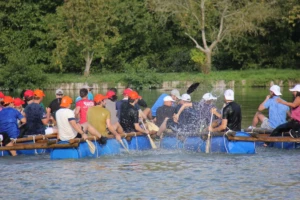
- Choosing the activity before the venue. The activity depends on the terrain. A canoe rally can only be done where there is a river. The venue first, the activity second: we have written a grid of seven criteria for the first choice.
- A changing capacity. “Between thirty and sixty” reserves neither a room nor bedrooms. Fix a number, even if it means correcting it by a few units in week 2.
- Three objectives. A seminar that addresses three subjects addresses none. One question, one decision.
- Forgotten transport. This is the item that arrives last in briefs and that decides the actual start time. Sort it out in week 4.
- Dietary requirements the day before. The kitchen adapts to everything, but what it receives three weeks in advance is in the menu; what it receives the day before is a separate plate.
If you only remember one thing: send the capacity and the date before everything else. The venue will do the rest with you, week after week. To see what the three houses offer in terms of rooms and bedrooms, compare them; for the formats, the corporate seminar page describes them one by one; for the activities, the twelve are detailed with what they require.
Do you have a date and a capacity? That is all we need to start. Send your brief: we will reply with the house, the rooms, the package and the adapted reverse schedule. Let’s build together
Frequently asked questions
How far in advance should a corporate seminar be organised?
Eight weeks are enough for a group of twenty to fifty people when the date and capacity are fixed from the first week. For a group of more than one hundred people, or for a high season date (May to mid-July, late August to October), you should aim for several months, because few houses can host it and their dates go first. The venue is booked before the programme, not after.
What is the purpose of a corporate seminar?
To achieve in one or two days what offices do not provide: a decision made together, an objective heard by everyone from the same mouth, and conversations outside the hierarchy. A seminar that has no question to address becomes an outing, and the participants sense it. The purpose must fit into one sentence, written in the brief sent to the venue, because it determines the format, the rooms and the rhythm.
Who organises corporate seminars?
Most often a personal assistant, an office manager or a person from human resources, appointed by a director or a department manager, sometimes with an agency. In all cases, the venue needs a single contact person on the company side, who decides on the capacity, the programme and the list of participants, and, on the venue side, a coordinated team: a sales representative who follows the file from the quote to departure and a house manager present on site.
How to structure a two-day seminar programme?
Day 1: welcome coffee, working session, lunch, group activity, break, free time, aperitif and dinner, evening in a private lounge, night. Day 2: breakfast, second working session, debrief and decisions, lunch, departure. A single working question per session, the same subgroups in the morning and afternoon, and a written debrief before departure: this is what links the seminar to the work that resumes.
What is the price of a corporate seminar?
There is no reliable national average, because packages do not contain the same things. What can be compared is a complete package per participant. At Groupe Moulin de la Forge, the all-inclusive residential package is published: from 295 to 345 € excl. VAT in a shared bedroom and from 350 to 410 € excl. VAT in a single bedroom, depending on the house and the season. Added to this are supervised activities, at published prices, and transport.
What must the brief sent to the venue contain to get a quote?
Six elements: the date or two possible dates; the number of participants and the format (study day or residential, single or shared bedrooms); the objective in one sentence; the desired arrival and departure times (start of the day, lunch, dinner, after breakfast, late afternoon); the planned activities; the budget per person. With this, the venue replies with the house, the rooms and the package.
Sources
- IFTM × Kactus, 2025 Corporate Events Barometer: budgets under pressure, preference for the train.
- Transilien, Line J timetables, Paris-Saint-Lazare to Chaumont-en-Vexin; time recorded on 25 September 2026.
- Groupe Moulin de la Forge, published residential packages and brief form, frequently asked questions (package content, access, private hire), recorded on 25 September 2026.